|
|
Clinical Service Staffing Model Development
Background:
The objective of the project is to update VA’s Clinical Nutrition Staffing Model, originally developed in 1998.
Staff from the Ann Arbor VA Health Services Research and Development (HSR&D) Center of Excellence
originally worked with a national committee of VA clinical dietitians during 1994-1998 in the development and validation of the original model.
Since completion and dissemination of the model in 1998,
and since collection of the original data for the model in 1995,
a number of important changes have occurred—both in the practice of clinical nutrition,
and in the collection of clinical nutrition data—which support updating the model.
In general, dietitians have significantly expanded their scope of practice in the performance of assessment,
education, and intervention activities. On the other hand, because of increasing financial constraints,
dietitians in some facilities are asked to provide the same level of services in less time during outpatient encounters.
Thus, the time data collected in 1995, which are a key component of the model,
does not accurately reflect the level of staff effort currently devoted to the provision of clinical nutrition services over 15 years later.
In addition, significant improvements in the capture of workload data have taken place in recent years.
As of FY 2006, the Event Capture System in DSS has collected detailed data on specific activities performed,
the nutrition status category of each patient seen, and the estimated time spent on each activity.
Therefore, the time data needed to update the staffing model could be obtained fairly readily from existing databases
—rather than through the extremely time consuming and costly process of maintaining daily logs,
as was used for the original staffing model study.
Currently no standard, validated methodology or algorithm for translating the DSS data into FTE requirements exists.
As VA faces increasing demands for patient care within a set of limited resources,
rigorously designed management tools are needed for facilitating decisions that can balance the provision of
high quality care with the most efficient delivery of that care. The theme of efficiency, in addition to quality,
permeates the healthcare landscape today, both within and outside VHA. One of VHA’s objectives,
identified in the Under Secretary for Health’s “Eight for Excellence” (2005),
is to “promote excellence in business practices through administrative, financial, and clinical efficiencies.”
A critical prerequisite to the efficient use of resources is to first determine the appropriate level of resources needed.
Model Design,Evaluation Methods,and Proposed Approach:
Like the original model, the updated staffing model will focus on patients as the units of analysis, not procedures or activities.
This is critical for planning for future staffing requirements,
as the planning process at the hospital level begins with an estimate of the number of patients who will seek care in the future.
Once the medical facility has agreed on this number,
then the individual clinical departments in the facility need to determine how many staff they will need to meet this demand.
Staffing requirements derived from the model will reflect the nature and quality of nutrition care currently provided to VA patients
—i.e., assume that the care currently provided is of the appropriate type and quality.
This assumption is consistent with the approach used by the Institute of Medicine in developing models for VA physician staffing.
However, like the Institute of Medicine, we will incorporate a “reconciliation strategy”
that allows for a balanced use of a statistically based and expert judgment model in the calculation of staffing requirements.
The model design will allow Nutrition and Food Service managers to review the time standards and then use
their professional judgment to adjust the standards as they deem appropriate to meet their local needs and context.
Thus, they will use the model to conduct sensitivity analyses under alternative scenarios.
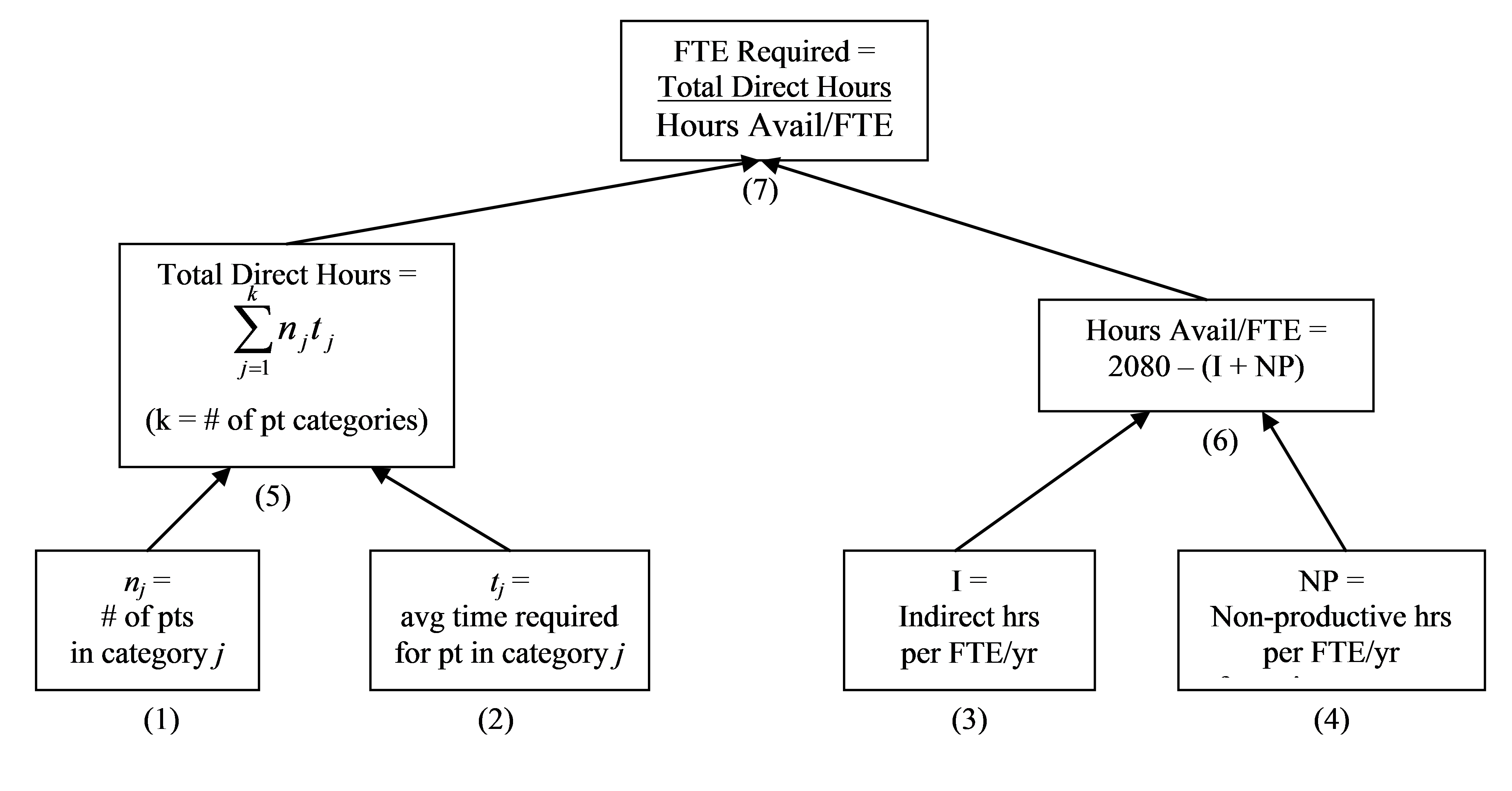
The framework used in the original model, and proposed for the updated model,
is derived from established engineering standards, and is shown below.
The primary data collection and analysis activities for the proposed project are determining the appropriate patient
categories for calculation of direct patient care hours (boxes 1, 2, and 5),
and calculation of the standard (average) time requirements for each patient category (box 2).
Estimation of demand for Services:
Data collection and analysis for estimating the demand for services will focus on determining the appropriate patient
categories for calculation of direct patient care hours (boxes 1, 2, and 5),
and calculation of the standard (average) time requirements for each patient category (box 2).
The specific steps involved in data collection and analysis for direct patient care hours are as follows:
1. Obtain Event Capture System (ECS) data from VA’s DSS on the given type of clinical service encounters
(such as nutritional services) from all medical centers for past FY or previous two fiscal years.
Aggregate the data by patient for inpatient episodes and outpatient visits.
2. Obtain matched data (by patient) from VA outpatient and inpatient treatment files on diagnoses,
clinic, inpatient unit, and length of stay.
3. Randomly divide the data into two data sets: one for model development and one for model validation.
4. Select appropriate patient variables that may affect total time needed per patient,
such as age, weight, diagnosis, nutrition status, etc.
5. Determine a significant set of independent variables that affect workload.
6. Determine the best clustering scheme for developing patient categories
such that the variation in time within each cluster is minimized,
the variation from cluster to cluster is significant, and the clusters are clinically meaningful.
7. Validate the model by comparing predicted time requirements for patients in the second data set with actual time spent (split-model validation).
Steps 5 and 6 execution will use Discrete Cluster Weighted Modeling (DCWM).
This approach for determining time requirements offers the following advantages:
1. Capability to consider and analyze many independent variables (discrete and continuous) and their interactions; and
2. Not imposing any constraint on the specific shape and structure for the model type, such as linear.
Estimation of Supply of Services:
Collection of data on indirect and non-productive hours is also needed for analysis as part of model development and validation,
as follows:
1. Conduct a two-week survey at a sample of VAMCs to determine the amount of time spent on indirect activities,
since these data are not included in ECS.
2. Obtain PAID data on leave usage (non-productive time) of clinical nutrition staff at each VAMC.
The results from these last two steps are necessary to develop empirical time standards for indirect and non-productive hours/FTE.
However, the model design is such that adjustment for this component is allowed by individual users to reflect local practice,
or to determine the effects of changes in indirect patient care responsibilities
(e.g., committee assignments, continuing education, supervision of trainees, etc.) of clinical nutrition staff at each medical center.
Dissemination of the updated model, as well as an evaluation of the effectiveness of dissemination efforts,
will take place in collaboration with HSR&D CoE Ann Arbor with the following steps:
1. Conduct surveys of nutrition clinical managers in VAMCs at the start of the study,
to obtain their feedback on use of the original staffing model, and their suggestions for improvements for the updated model.
The clinical nutrition managers have already requested that the updated model must reflect a user-friendly desktop version to facilitate its use.
2. Incorporate the feedback from (1) into model design and dissemination.
Post the new model on the Nutrition and Food Service Web site,
and conduct training via the Clinical Managers Advisory Council’s monthly education conference calls.
3. Three months after completion of dissemination activities,
conduct a follow-up survey of nutrition clinical managers to obtain their feedback on model use.
Proposed Work
In this project, our group will accomplish the following tasks:
1. Develop and implement a data pulling/collection methodology,
through mining of electronic data sources and conducting surveys,
and motion/time study to obtain relevant clinical supply/demand data that is sufficient to develop the staffing model,
with appropriate selection of independent and dependent variables.
2. Collaborate with HSR&D CoE Ann Arbor on data identification, collection, assessment, and surveys.
3. Conduct project reviews and status reports at least monthly or as otherwise mutually agreed to,
providing status on work performed, accomplished,
and planned; and identify any obstacles that were encountered, strategies to overcome these obstacles,
and any schedule modifications.
4. Incorporate all feasible and mutually agreed to recommendations within the scope of this effort.
5. Develop and implement a modeling approach for one type of clinical service staff,
the nutritionist, as a basis for method development to support other clinical areas.
This nutritional staffing work load estimation model will provide:
• A set of patient categories (clusters), each defined by a given set of relevant patient information,
such as age, disease type (diagnosis), nutrition status, etc.
• Estimated workload (hours/year) for each category of patients, with mean, 10th and 90th percentiles.
6. Validate the model.
7. Develop a supply side capacity model; specifically, provide total available service hours for nutritional staff.
8. Develop a configurable and extensible computer tool that meets VA OI&T
web enabled requirements to implement the staffing model and provide decision support capabilities.
9. Conduct a follow-up survey of model use ini collaboration with HSR&D CoE.
10. Develop a configurable and extensible web based platform, and upload the tool onto the VA network.
11. Develop an easy-to-learn data pulling procedure, based on effort above,
to obtain needed data from VA data support systems, for extension to support staffing of other clinical services.
Related funded projects
Clinical Services Staffing Webtool Development, US Department of Veteran Affairs, (PI 50%) $150,000, 5/13-4/14
|

